Great lines from Middlemarch
On zingers

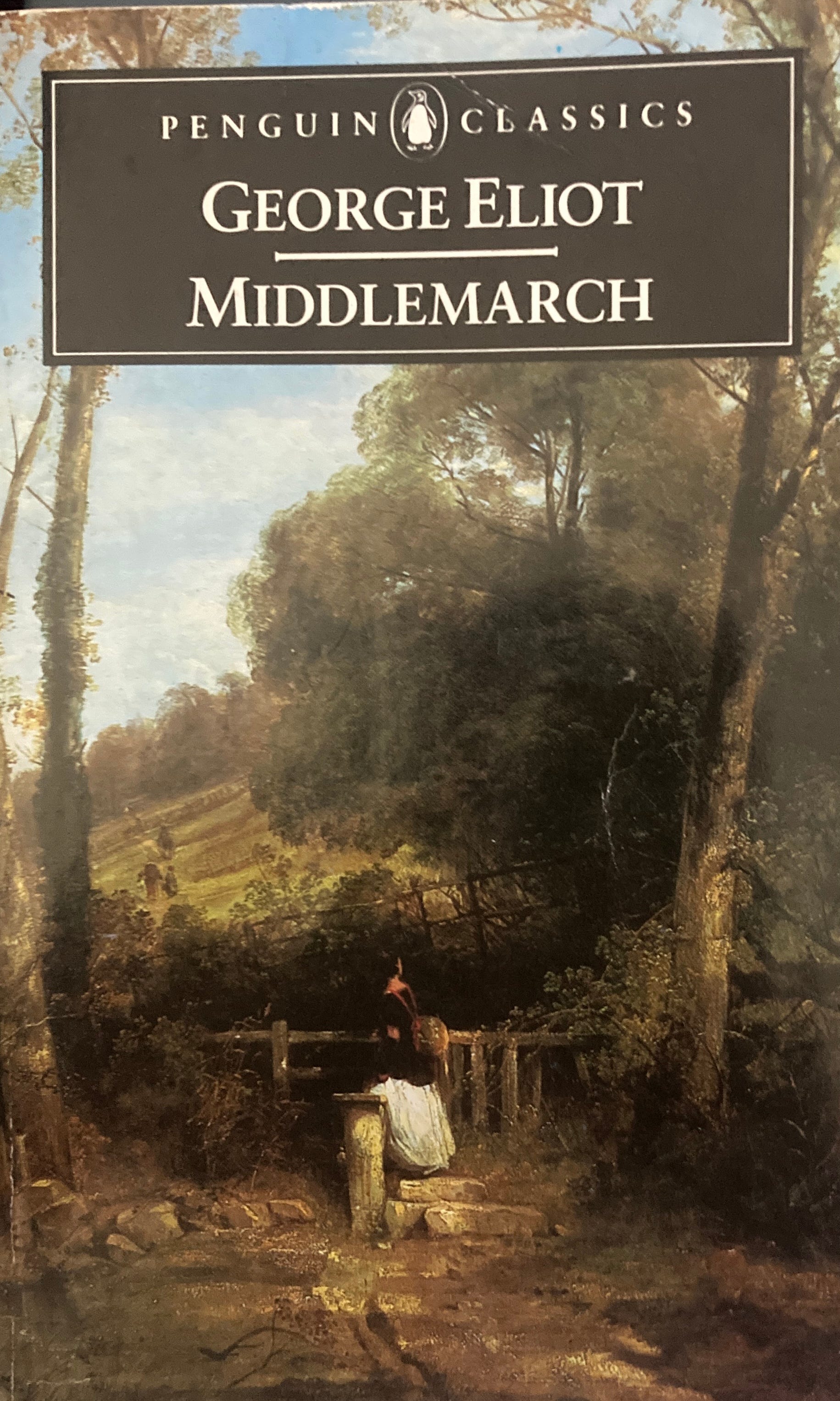
Middlemarch is one of those big, sprawling 19th Century novels it’s great to get lost in for months at a time.
But “George Eliot” is a downright whiskery name, so I will call the woman who wrote this fabulous novel by her real name, Mary Ann Evans.
In less than 200 pages, Mary Ann has created a rich world with sharp characters, an interesting place (the Midlands of England in the 1820s) and several plot threads, including a couple marriage plots that drove the action in so many books back then.
The emerging themes include gender roles, medicine, money, social causes, provincial life and the role religion played in society, just to name a few.
But I would argue the real joy so far is that Mary Evans knows how to toss out some zingers.
Here’s a few I’ve noted so far. I’m reading a Penguin Classics edition from 1988:
“I don’t think it would be nice to marry a man with a great soul.” Pg. 79.
“It’s a very good quality in a man to have a trout stream.” Pg. 95
And I love this exchange between Sir James and Mrs. Cadwallader talking about the old, morose, bookish Casaubon who is poised to marry the young, idealistic Celia Brooke who has a disdain for “fripperies.”
“He’s got no good red blood in his body,” said Sir James.
“No, somebody put a drop under a magnifying-glass and it was all semi-colons and parentheses,” Mrs. Cadwallader said. Pg. 96
And more:
“In fact, the world is full of hopeful analogies and handsome dubious eggs called possibilities.” Pg. 109
“I am not sure that the greatest man of his age, if ever that solitary superlative existed, could escape these unfavorable reflections of himself in various small mirrors, and even if Milton, looking for his portrait in a spoon, must submit to have the facial angle of a bumpkin.” Pg. 110
“Blameless people are always the most exasperating.” Pg. 143.
“And to me it is one of the most odious things in a girl’s life, that there must always be some supposition of falling in love coming between her and any man who is kind to her, and to whom she is grateful. I should have thought that I, at least, might have been safe from all that. I have no ground for the nonsensical vanity of fancying everybody who comes near me is in love with me.” Pg. 165
“When a conversation has taken a wrong turn for us, we only get farther and farther into the swamp of awkwardness.” Pg. 167